

Towards Real-Time Diffusion-Based Streaming Video Super-Resolution
Authors: Junhao Zhuang, Shi Guo, Xin Cai, Xiaohui Li, Yihao Liu, Chun Yuan, Tianfan Xue





Your star means a lot for us to develop this project! ⭐
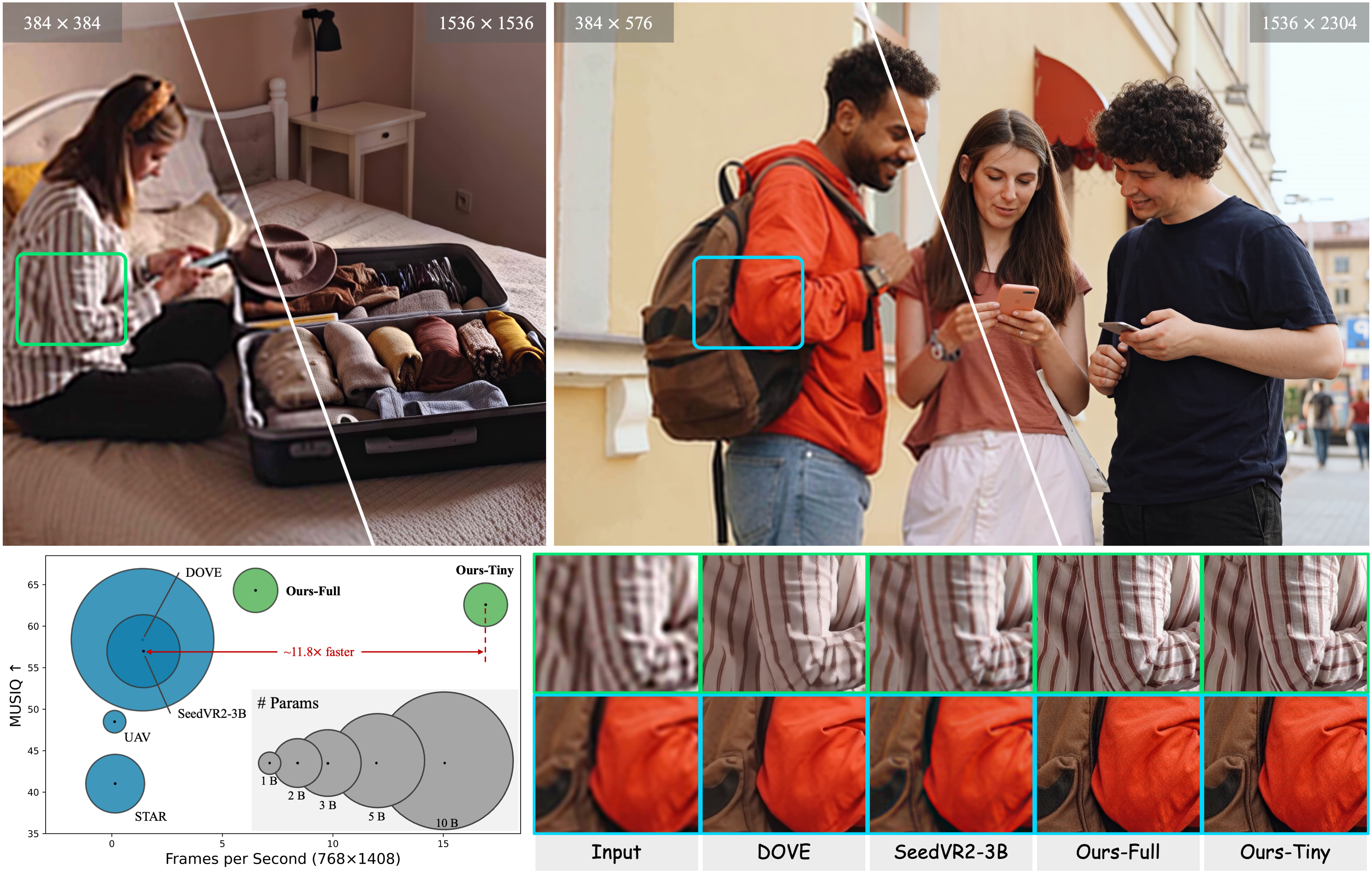
Diffusion models have recently advanced video restoration, but applying them to real-world video super-resolution (VSR) remains challenging due to high latency, prohibitive computation, and poor generalization to ultra-high resolutions. Our goal in this work is to make diffusion-based VSR practical by achieving efficiency, scalability, and real-time performance. To this end, we propose FlashVSR, the first diffusion-based one-step streaming framework towards real-time VSR. FlashVSR runs at ∼17 FPS for 768 × 1408 videos on a single A100 GPU by combining three complementary innovations: (i) a train-friendly three-stage distillation pipeline that enables streaming super-resolution, (ii) locality-constrained sparse attention that cuts redundant computation while bridging the train–test resolution gap, and (iii) a tiny conditional decoder that accelerates reconstruction without sacrificing quality. To support large-scale training, we also construct VSR-120K, a new dataset with 120k videos and 180k images. Extensive experiments show that FlashVSR scales reliably to ultra-high resolutions and achieves state-of-the-art performance with up to ∼12× speedup over prior one-step diffusion VSR models.
- Release Date: October 2025 — Inference code and model weights are available now! 🎉
- Coming Soon: Dataset release (VSR-120K) for large-scale training.
- ✅ Release inference code and model weights
- ⬜ Release dataset (VSR-120K)
Follow these steps to set up and run FlashVSR on your local machine:
git clone https://github.com/OpenImagingLab/FlashVSR
cd FlashVSR
Create and activate the environment (Python 3.11.13):
conda create -n flashvsr python=3.11.13
conda activate flashvsr
Install project dependencies:
pip install -e .
pip install -r requirements.txt
FlashVSR relies on the Block-Sparse Attention backend to enable flexible and dynamic attention masking for efficient inference.
git clone https://github.com/mit-han-lab/Block-Sparse-Attention
cd Block-Sparse-Attention
pip install packaging
pip install ninja
python setup.py install
⚠️ Note: The Block-Sparse Attention backend currently achieves ideal acceleration only on NVIDIA A100 or A800 GPUs (Ampere architecture). On H100/H800 (Hopper) GPUs, due to differences in hardware scheduling and sparse kernel behavior, the expected speedup may not be realized, and in some cases performance can even be slower than dense attention.
Weights are hosted on Hugging Face via Git LFS. Please install Git LFS first:
# From the repo root
cd examples/WanVSR

# Install Git LFS (once per machine)
git lfs install

# Clone the model repository into examples/WanVSR
git lfs clone https://huggingface.co/JunhaoZhuang/FlashVSR
After cloning, you should have:
./examples/WanVSR/FlashVSR/
│
├── LQ_proj_in.ckpt
├── TCDecoder.ckpt
├── Wan2.1_VAE.pth
├── diffusion_pytorch_model_streaming_dmd.safetensors
└── README.md
The inference scripts will load weights from
./examples/WanVSR/FlashVSR/by default.
# From the repo root
cd examples/WanVSR
python infer_flashvsr_full.py      # Full model
# or
python infer_flashvsr_tiny.py      # Tiny model
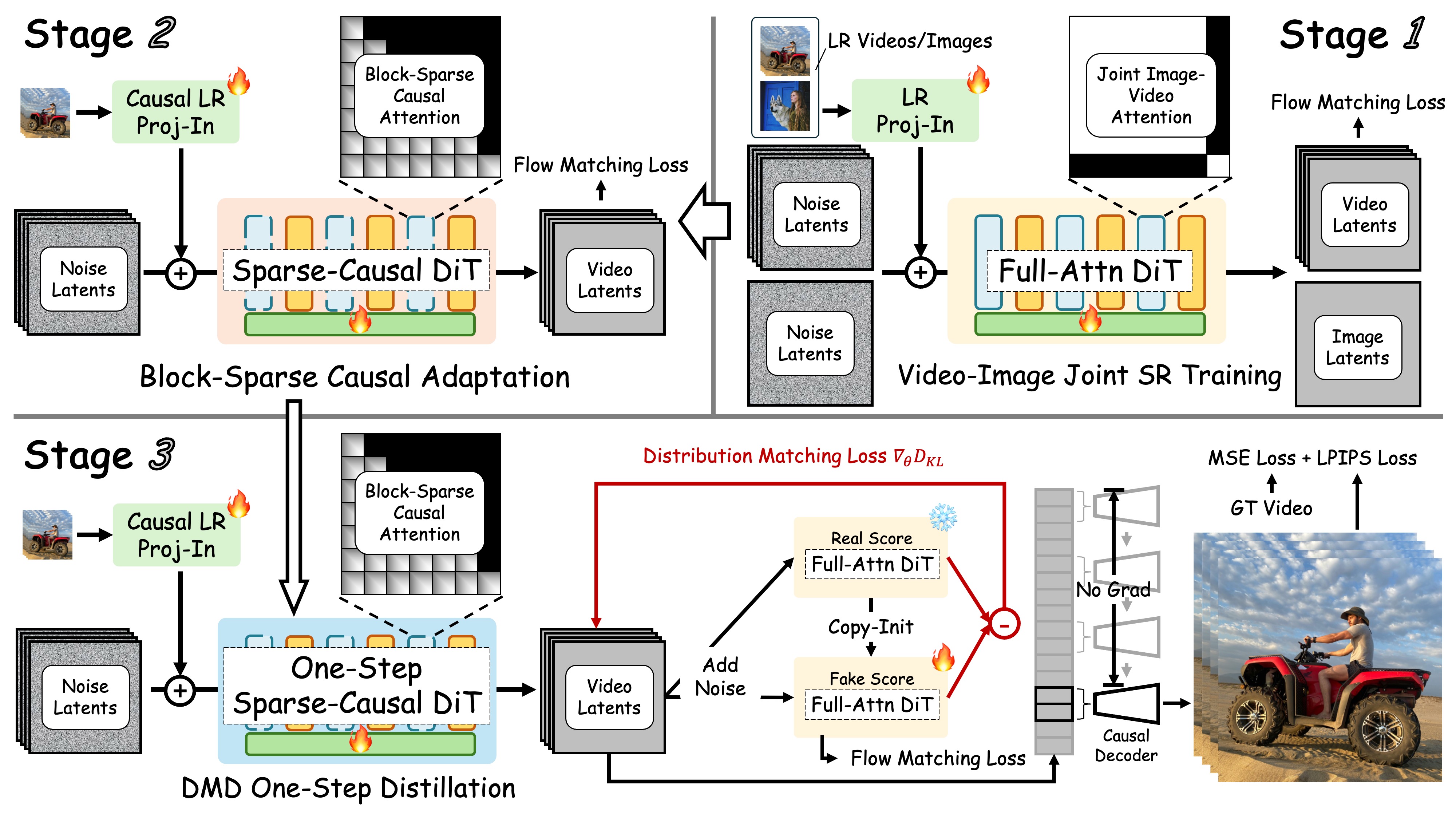
The overview of FlashVSR. This framework features:
- Three-Stage Distillation Pipeline for streaming VSR training.
- Locality-Constrained Sparse Attention to cut redundant computation and bridge the train–test resolution gap.
- Tiny Conditional Decoder for efficient, high-quality reconstruction.
- VSR-120K Dataset consisting of 120k videos and 180k images, supports joint training on both images and videos.
We welcome feedback and issues. Thank you for trying FlashVSR!
We gratefully acknowledge the following open-source projects:
- DiffSynth Studio — https://github.com/modelscope/DiffSynth-Studio
- Block-Sparse-Attention — https://github.com/mit-han-lab/Block-Sparse-Attention
- taehv — https://github.com/madebyollin/taehv
- Junhao Zhuang Email: zhuangjh23@mails.tsinghua.edu.cn
@misc{zhuang2025flashvsrrealtimediffusionbasedstreaming,
      title={FlashVSR: Towards Real-Time Diffusion-Based Streaming Video Super-Resolution},
      author={Junhao Zhuang and Shi Guo and Xin Cai and Xiaohui Li and Yihao Liu and Chun Yuan and Tianfan Xue},
      year={2025},
      eprint={2510.12747},
      archivePrefix={arXiv},
      primaryClass={cs.CV},
      url={https://arxiv.org/abs/2510.12747},
}
