









Secure Document Collaboration. Controlled by You.
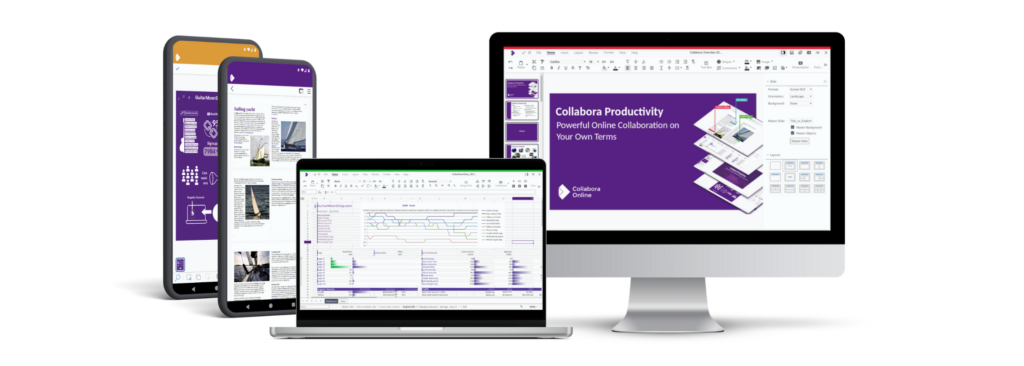
- Collabora Online Development Edition (CODE)
- Collabora Online
- Collabora Office
- Collabora Office for iOS and Android
- For additional details, build instructions, downloads, and more, please visit collaboraonline.github.io. You can also explore the SDK Documentation.
- View and edit text documents, spreadsheets, presentations & more
- Collaborative editing features
- Works in any modern browser – no plugin needed
- Integrate, extend and customise
- Open Source – primarily under the MPLv2 license. Some parts are under other open source licences, see e.g. browser/LICENSE.
To integrate Collabora Online into your own solution, you can see our step-by-step tutorial, view the available integrations, understand the post message API used to customize and interact with Collabora Online, and a lot more.
Set up Nextcloud or ownCloud on localhost and install the richdocuments app, or explore other integrations that can be used to test Collabora Online at https://www.collaboraonline.com/integrations/.
Good tutorials exist how to install ownCloud or Nextcloud, we don't repeat them here. richdocuments is called Collabora Online in the respective app stores / marketplaces / whatever.
When you have a running Nextcloud or ownCloud instance at http://localhost/nextcloud or at http://localhost/owncloud go to Collabora Online settings, and set the WOPI URL to http://localhost:9980
Then in the build tree, edit the generated coolwsd.xml and set ssl setting to false. You can run make run, and test coolwsd with the ownCloud or Nextcloud integration.
Note: if SSL is enabled in either Online or the integration, both must have SSL enabled. That is, you must access NC/OC usingNote: well as configure the Collabora Online endpoint in NC/OC as https://localhost:9980.
Do you want a ready-to-go or simplified solution? Find a trusted vendor from our list of global partners who integrate and host Collabora Online.
Please ask your questions on any of the bridged Matrix/Telegram rooms
- Matrix: #cool-dev:matrix.org
- Telegram: CollaboraOnline
Join the conversation on our Discourse server at https://forum.collaboraonline.com/
Watch the tinderbox status (if it's green) at https://cpci.cbg.collabora.co.uk:8080/job/Tinderbox%20for%20online%20master%20against%20co-24.04/
This project has several components:
- wsd/
- The Web Services Daemon - which accepts external connections
- kit/
- The client which lives in its own chroot and renders documents
- common/
- Shared code between these processes
- browser/
- The client side JavaScript component
- test/
- C++ based unit tests
- cypress_test/
- JavaScript based integration tests
See the corresponding web pages:
Releases and pre-release builds are made from the
distro/collabora/co-25.04-mobile branch. Releases for Android and iOS are
generally built from the same commit, and are tagged as a release on GitHub.
Android snapshots are automatically built once a week, but may be built more frequently if there's something new to test. iOS testflight builds are exclusively built when there is something new to test. Pre-release builds are not tagged in GitHub.
You should still develop against master, even if you're working on
mobile-only features. Changes made in master will be moved into the
distro/collabora/co-25.04 branch according to the release schedule. Changes
from the distro/collabora/co-25.04 branch are then regularly cherry-picked
into the distro/collabora/co-25.04-mobile branch.
If you have a change which you want to get into mobile snapshots or releases
more quickly, you should still develop it against master. When it's merged
into master, you should make a backport pull request against
distro/collabora/co-25.04-mobile. Please don't make pull requests directly
against distro/collabora/co-25.04-mobile (i.e. without the change first being
merged into master).
Head over to https://collaboraonline.github.io/post/build-code/#build-code-on-gitpod and follow the steps.
You can access the admin panel by directly accessing the admin.html file from browser directory.
Websocket connections to admin console can be made at path: /adminws/ on the
same url and port as coolwsd is running on. However, one needs a JWT token to
authenticate to the admin console websocket. This is stored as a cookie with
Path: /adminws/ when user successfully authenticates when trying to access
/browser/dist/admin/admin*html files (HTTP Basic authentication). Token
is expired after every half an hour, so websocket connection to admin console
must be established within this period.
It should also be possible to do various sorts of tasks such as killing documents that are open for more than 10 hours etc. See protocol.txt for various commands. Only tricky thing here is getting the JWT token which can be obtained as described above.
See protocol.txt for a description of the protocol to be used over the websocket.
Please refer to https://sdk.collaboraonline.com/docs/architecture.html
